
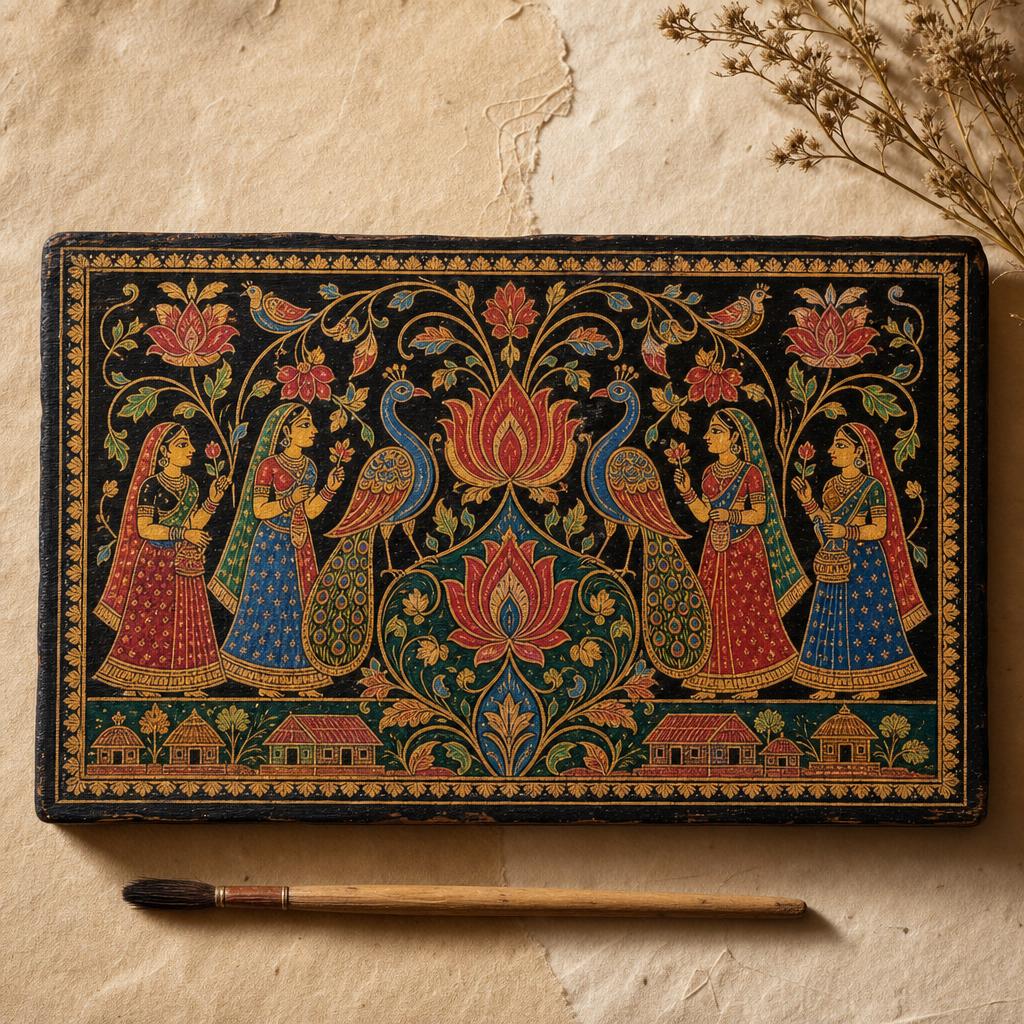
Tikuli Art of Bihar: From Bindi to Painted Story
In Bihar, a tiny ornament once worn at the centre of the forehead grew into an entire language of painted storytelling. Tikuli is the local word for the bindi—a small mark, but one filled with ideas of beauty, identity, auspiciousness, and attention.
From its historic roots in Patna’s glass workshops to its contemporary life on painted wooden panels, Tikuli art carries a remarkable story of adaptation. What began as the making of jewel-like bindis now unfolds across scenes of village life, festivals, nature, mythology, and the everyday worlds of women.
What Is Tikuli Art?
Tikuli art is a decorative painting tradition associated with Patna, Bihar. Its name comes from the colloquial word tikuli, meaning bindi—the circular adornment traditionally worn between the eyebrows.
The historic craft and the painting practiced today are related, but they are not identical. Earlier tikulis were delicate ornaments made on glass, often embellished with metallic foil and fine painted detail. Contemporary Tikuli painting preserves their polished darkness, luminous colour, intricate lines, and jewel-like finish while expanding the scale from a tiny forehead ornament to panels, trays, boxes, coasters, wall plates, and narrative artworks.
The result is immediately recognizable: a deep black ground animated by bright reds, greens, blues, and gold; finely controlled outlines; compact ornamental borders; and figures rendered with an elegant folk-art directness.
From Patna’s Glass Workshops
Tikuli is commonly described as an old Patna tradition, with Bihar Tourism tracing its history across many centuries. Historic accounts describe artisans shaping thin pieces of glass into bindis, adding gold foil and pigments, and polishing them to create a brilliant surface. Their lustre made them treasured adornments and connected the craft to the social and ceremonial lives of women.
Like many handmade traditions, Tikuli changed under the pressure of industrial production. Inexpensive, machine-made bindis offered speed, uniformity, and broad availability. The laborious glass tradition declined, and the knowledge surrounding it came close to disappearing.
Its survival did not depend on freezing the craft in its earlier form. Instead, Tikuli found new life by changing its surface and scale.
A Craft Reimagined
The twentieth-century artist and designer Upendra Maharathi is widely credited with helping revive and reinterpret Tikuli in Bihar. Deeply engaged with regional craft traditions, Maharathi encouraged a shift from fragile glass ornaments toward painted decorative panels and useful objects. This allowed the visual language of Tikuli to travel into homes, exhibitions, and new markets.
Artisans began working on hardboard and, later, wooden or MDF surfaces. The black base recalled the dark brilliance of traditional tikulis, while the larger format created room for narrative scenes. A single circular motif could now become a tree of life, a procession, a moment from Krishna’s story, a celebration of Chhath, or a portrait of daily work.
This reinvention is part of Tikuli’s identity. The tradition lives not because it remained unchanged, but because makers carried its essential visual memory into a form that could meet another time.

How a Tikuli Painting Is Made
Methods vary between workshops and artists, but the contemporary process generally moves through several patient stages.
1. Preparing the surface
A hard, smooth base—often wood, hardboard, or MDF—is cut into the required form. It may become a rectangular panel, a circular wall plate, a tray, or a small decorative object.
2. Building the black ground
The surface is coated and polished to create the rich black field that gives Tikuli its distinctive depth. This darkness is not empty background; it acts like a night sky, making every painted colour appear more luminous.
3. Drawing the composition
The artisan plans the figures, borders, flowers, animals, and narrative details. Balanced arrangements and rhythmic repetition help even complex scenes feel ordered.
4. Painting in fine layers
Bright colours are applied with small brushes. Red, green, blue, yellow, and metallic gold are common, although each artist develops an individual palette. The careful separation of colour areas preserves clarity against the dark base.
5. Outlining and ornament
Fine lines define faces, garments, leaves, feathers, jewellery, and architectural details. Dots, curls, petals, and repeated borders echo the precision of the original bindi-sized craft.
6. Finishing
A protective coating gives the work durability and a gentle sheen, completing the lacquer-like appearance associated with modern Tikuli objects.
A Visual Language of Celebration
Tikuli paintings frequently draw from the cultural landscape of Bihar and the broader narrative traditions of India. Krishna and Radha, wedding scenes, Chhath Puja, village markets, musicians, dancers, trees, birds, fish, and floral patterns all appear within its dark, radiant frames.
Women often occupy the centre of these compositions—as worshippers, musicians, workers, mothers, dancers, and participants in community life. This is especially meaningful for a craft that began with an ornament worn by women and is now practiced by many women artisans.
The images are decorative, but they are not merely decoration. They preserve gestures: carrying water, preparing for a festival, gathering beneath a tree, playing music, offering prayer. Through repetition and pattern, ordinary moments acquire ceremony.
Precision, Livelihood, and Living Heritage
Tikuli painting demands steadiness more than spectacle. Its power comes from controlled lines, patient layering, and the accumulation of small details. That concentration is easy to overlook when the finished surface appears so effortless.
Today the craft supports artisan livelihoods and offers opportunities for home-based work, including for women who balance making with family responsibilities. Workshops, cooperatives, design institutions, museums, and individual master artisans have all contributed to keeping the tradition visible.
Yet revival is never complete. Handmade Tikuli must compete with printed décor and factory-made objects that imitate its surface without carrying its labour. Sustaining the craft means recognizing authorship, paying fairly for time and skill, and allowing artists to innovate without reducing their work to a generic “folk” style.
Tikuli in the Contemporary Home
On a wall or tabletop, Tikuli art brings both drama and intimacy. The black ground gives a room visual depth; gold lines catch the light; saturated colour creates focus without requiring a large scale.
Its smaller objects—boxes, trays, coasters, and wall plates—also reveal the craft’s origin in personal adornment. Like the historic bindi, they concentrate extraordinary detail within a contained surface. Larger panels extend that intimacy into storytelling, inviting the viewer to move slowly through each figure, border, and flowering branch.
A Small Circle, an Expanding Story
At The Parijat Tree, we are drawn to traditions that show how craft can remember and renew at the same time. Tikuli art holds the memory of Patna’s glass bindis, yet its contemporary painted form continues to evolve through the hands and imaginations of Bihar’s artisans.
Its story reminds us that preservation is not always a return to the past. Sometimes it is a careful translation: from glass to wood, from ornament to narrative, from a luminous dot to an entire painted world.
Every craft has a story, Every story a soul.
Sources and further reading: Bihar Tourism: Tikuli Painting; Rooftop Art Wiki: Tikuli Art; Bihar Museum.
Image note: The hero and process visuals are original editorial illustrations created for The Parijat Tree. They are interpretive representations of Tikuli’s materials and visual vocabulary, not documentary photographs of a specific artwork or artisan.