
Sholapith Art of Bengal: Sculpting Stories from a Wetland Plant
Across Bengal’s marshes and waterlogged fields grows an unassuming plant with a remarkable interior. Beneath its brown outer skin, the shola stem holds a soft, luminous white pith—light enough to float, supple enough to slice into paper-thin sheets, and responsive enough to become flowers, crowns, deities, birds, boats, and intricate architectural forms.
In the hands of skilled artisans, this humble wetland plant becomes sholapith art: a living tradition shaped by ritual, ecology, and generations of patient handwork.
What Is Sholapith?
Sholapith is the dried inner core of the shola plant, most commonly identified as Aeschynomene aspera, an annual aquatic herb that grows wild in marshy and waterlogged parts of eastern India. The material is sometimes called “Indian cork” because it is exceptionally light, porous, and easy to shape.
Its naturally milky-white surface has also earned it the poetic name “herbal ivory.” The comparison describes its appearance and carving potential—not its origin. Unlike animal ivory, sholapith is plant-based and biodegradable.
Although the craft is especially associated with West Bengal, related traditions are also practiced in parts of Odisha and Assam. Within Bengal, important craft centres have developed distinct local styles, from the delicately ornamented work of Bankapasi in Purba Bardhaman to communities in Murshidabad, Nadia, Hooghly, and the South 24 Parganas.
A History Rooted in Ritual
Sholapith does not have one securely documented moment of origin. Its history is instead woven through Bengal’s ceremonial life, where the material has long been used for weddings, festivals, worship, and seasonal decoration.
The artisans traditionally associated with the craft are known as Malakars—literally, makers of garlands. Their work can be seen in the ornate topor worn by a Bengali groom and the mukut worn by a bride. Shola flowers, crowns, garlands, and sculptural details also adorn sacred images, particularly during Durga Puja. The bright white material catches light beautifully, allowing artisans to create elaborate volume without burdening a temporary structure with great weight.

Over time, artisans expanded this ritual vocabulary into freestanding sculptures, miniature boats and chariots, birds, animals, dolls, floral arrangements, wall panels, and souvenirs. Shola was also historically used to make lightweight sun helmets, another reason the material became known beyond eastern India.
From Wetland Stem to White Canvas
The transformation begins long before an artisan makes the first cut.
1. Growing and harvesting
Shola grows in standing water and wet ground. Mature stems are harvested at the appropriate season, when their inner pith has developed enough body and brightness for craft use.
2. Trimming and drying
The stems are cleaned, cut into manageable lengths, and dried in the sun. As the green outer surface turns brown, the moisture recedes and the white core becomes ready to work.
3. Revealing the pith
Artisans remove the outer bark with a sharp knife. The quality of the exposed core—its whiteness, diameter, evenness, and freedom from marks—helps determine how it can be used.
4. Cutting sheets and forms
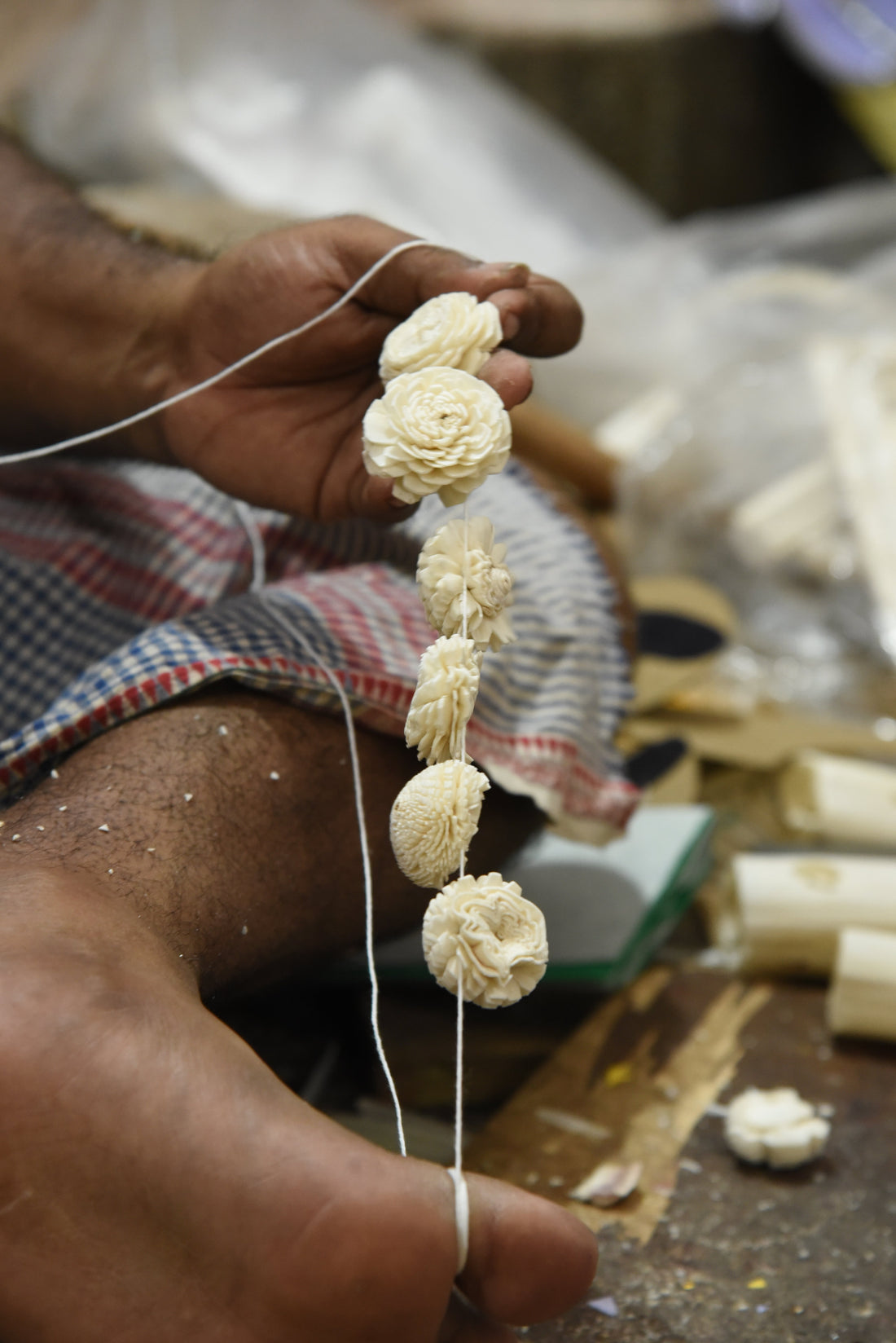
With practiced control, the pith may be sliced into thin, continuous sheets or cut into blocks, strips, petals, and geometric units. A small knife does much of the work, but the true tools are steady fingers and an intimate understanding of how the material responds to pressure.
5. Shaping and assembling
Individual pieces are carved, curled, scored, layered, and joined to build depth. Repeated petals become flowers; tiny cut forms become borders; sheets become garments, feathers, foliage, and architectural detail. The material’s lightness makes astonishingly intricate constructions possible.
The Hand Behind the Delicacy
Sholapith can resemble paper from a distance, but it behaves differently under the blade. A cut that is too deep can break a petal; uneven pressure can bruise the white surface; a poorly chosen stem may reveal hidden flaws. Mastery lies in making hundreds of exacting decisions appear effortless.
Craft knowledge has traditionally moved through families and workshops by observation and repetition. Artisans learn not only motifs, but also how to select raw stems, judge moisture, sharpen tools, and improvise when natural material refuses to behave uniformly. This is why two pieces built from the same design are never entirely identical.
A Craft Shaped by Its Landscape
Sholapith is inseparable from wetlands. The plant, the harvest cycle, and the artisan’s livelihood all depend on healthy waterlogged landscapes and access to good raw material. That connection gives the craft an environmental relevance that extends beyond the finished object.
As a natural material, shola is renewable and biodegradable. Yet those qualities alone do not guarantee a sustainable craft economy. Wetland loss, inconsistent material supply, seasonal demand, low returns for painstaking work, and competition from moulded foam and plastic decorations all place pressure on artisan communities.
Preservation therefore means more than keeping an old technique visible. It means valuing skilled labour, supporting living craft centres, protecting the landscapes that produce the plant, and creating thoughtful contemporary uses without erasing the tradition’s ceremonial roots.
Sholapith in the Contemporary Home
Today, designers and artisans are adapting sholapith into botanical sculptures, wreaths, lighting, framed compositions, wedding décor, and quiet objects for the home. Its matte white tone brings softness and shadow to an interior, while its hand-cut edges reveal the humanity of the making process.
Shola flowers are especially expressive. They capture the gesture of a bloom without attempting perfect imitation: every curled petal carries the trace of a blade, every variation reminds us that the material once grew in water.
The Beauty of a Living Tradition
At The Parijat Tree, we are drawn to materials that carry place, memory, and the touch of the maker. Sholapith holds all three. It begins as a wild wetland stem and becomes, through patience and imagination, an object of ceremony and wonder.
To bring sholapith into the home is to appreciate more than its delicacy. It is to honour the ecology that grows it, the communities that understand it, and the hands that transform a fragile white core into enduring cultural expression.
Every craft has a story, Every story a soul.
Sources and further reading: Naturally Bengal: Shola—The Ivory from Plants; Sahapedia: Sholapith—Herbal Ivory of Bengal; Government of West Bengal: Arts and Crafts.
Image credits: “6 out of 8 types of traditional flower designs made out of sholapith” and “First band of sholapith flowers being applied to the cardboard frame” by Prakriti Panda, via Wikimedia Commons, licensed under CC BY-SA 4.0. Hero image source · Process image source.