
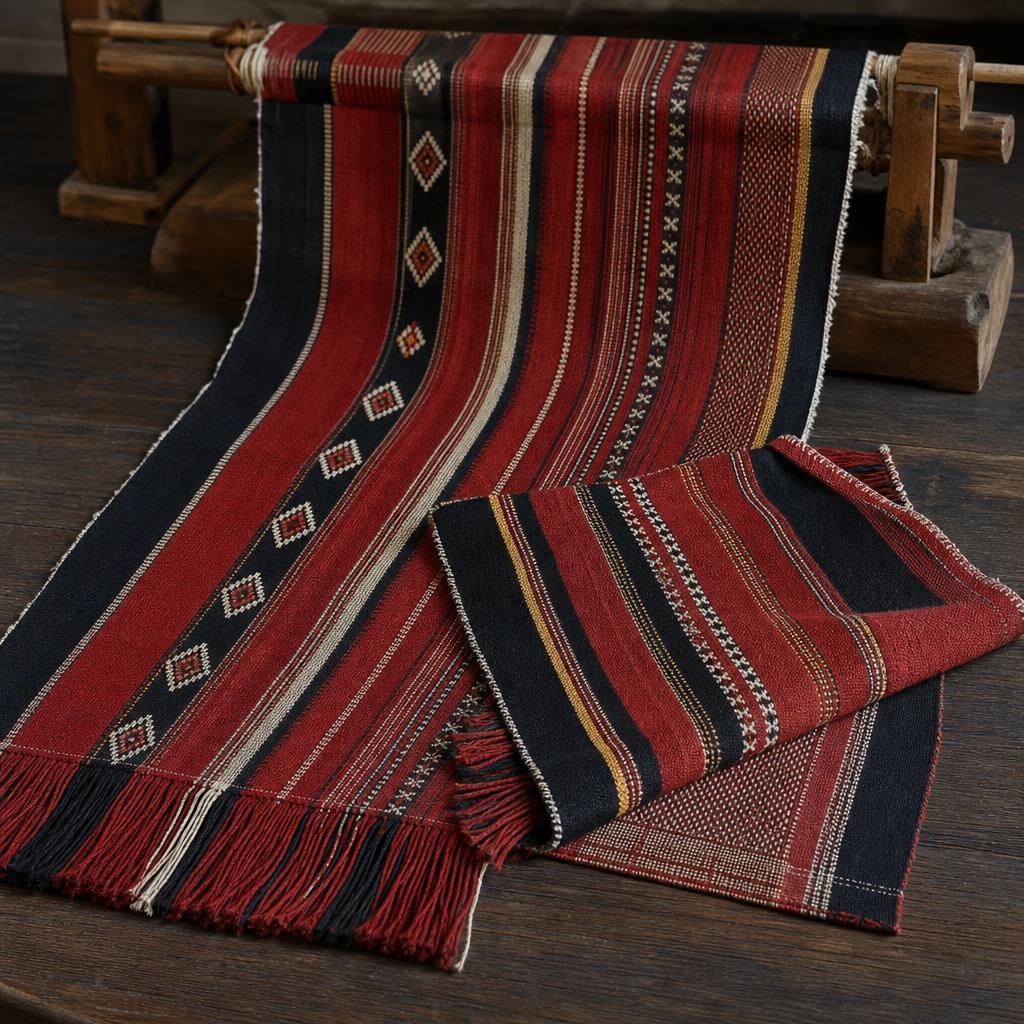
Naga Weaving: Threads of Identity from Nagaland
Across the hills of Nagaland, cloth carries more than colour. A woven band can speak of community, belonging, memory, responsibility, and the skill of the woman who brought warp and weft together. Bold from a distance and extraordinarily precise up close, Naga textiles turn simple geometric structures into powerful cultural expression.
It is important to begin in the plural. “Naga weaving” is not one uniform style. Nagaland is home to many distinct communities, each with its own histories, garments, colour relationships, motifs, and rules of use. What connects them is not a single pattern, but a deep textile culture shaped by handspun knowledge, narrow looms, and generations of women weavers.
A Textile Language, Not Just a Pattern
Traditional textiles in Nagaland have long helped make social identity visible. Shawls, wrap skirts, loincloths, bags, and ceremonial garments may indicate community affiliation, age, gender, social standing, or achievement. In some traditions, particular motifs or forms were historically connected with earned status and could not simply be chosen as decoration.
This is why a Naga-inspired geometric pattern is not interchangeable with a culturally specific textile. Stripes, diamonds, stepped forms, squares, and bands acquire meaning through their relationship to a particular community and context. Respect begins by recognizing that design can carry knowledge and rights, not merely visual appeal.
The Intimacy of the Backstrap Loom
Many traditional cloths are woven on the loin loom, also called a backstrap loom. It is compact, portable, and deceptively simple: one end of the warp is secured to a post or wall, while the other is attached to a strap around the weaver’s back. By leaning forward or backward, she controls the tension.
The loom has no heavy frame. The weaver’s body becomes part of its structure—measuring resistance, opening the shed, passing the weft, and beating each line into place. Because the loom commonly produces narrow panels, wider garments may be assembled by joining carefully aligned lengths of cloth.

From Cotton to Cloth
Historically, cotton could be cultivated, cleaned, spun, dyed, and woven close to home. The complete process required knowledge at every stage: preparing fibre, sizing and arranging the warp, calculating stripe sequences, controlling tension, and finishing the joined cloth.
Red, black, white, and deep blue are strongly associated with many textiles from Nagaland, but their arrangement and significance vary. Earlier dye traditions drew on locally available plant materials, including indigo, while contemporary weavers also use commercially spun yarns and dyes. Change in material does not erase the hand intelligence required at the loom.
How the Weaving Takes Shape
1. Planning the cloth
The weaver determines the width, colour order, bands, and any supplementary motifs before setting the warp.
2. Preparing and tensioning the warp
Long parallel threads are measured and arranged. On a backstrap loom, their tension will be adjusted continuously through the weaver’s posture.
3. Building the ground
The weft passes rhythmically through the warp. Repeated stripes require close counting so that bands remain consistent across separate panels.
4. Adding motifs
More complex details may be introduced through supplementary weaving techniques. Each small figure is constructed thread by thread rather than printed onto the finished surface.
5. Joining and finishing
Narrow widths can be stitched together with careful alignment. Fringe, tassels, or additional ornament may complete the garment.
Women, Memory, and Mastery
Weaving knowledge has traditionally moved through observation and practice: a younger weaver watching how an experienced hand controls tension, counts a repeat, or corrects an uneven edge. The loom often belongs within domestic life, yet the work it produces can carry public and ceremonial significance.
This relationship also reveals a familiar imbalance. Women may hold immense technical and cultural knowledge while receiving limited recognition or financial return. Supporting living weaving traditions means valuing the maker, naming the community when known, and understanding that “handmade” describes skilled labour—not an effortless aesthetic.
Tradition in a Changing Market
Contemporary weavers and designers in Nagaland are adapting loin-loom techniques into stoles, bags, table textiles, jackets, and other forms suited to present-day use. These experiments can create livelihoods and encourage younger generations to learn. They can also raise difficult questions about attribution, cultural ownership, and the copying of motifs outside their context.
A thoughtful future for Naga weaving must therefore hold two ideas together: traditions need room to evolve, and culturally meaningful designs deserve respect. Collaboration works best when communities guide how their textiles are represented and benefit directly from their use.
Cloth as a Living Archive
At The Parijat Tree, we are drawn to objects that reveal the intelligence of the hand. In Naga weaving, that intelligence is inseparable from the body: the weaver leans into the warp, senses its tension, and builds a cloth one measured line at a time.
To encounter these textiles with care is to look beyond a striking palette. It is to recognize many communities, many design languages, and many women whose knowledge has made cloth into a living archive.
Every craft has a story, Every story a soul.
Sources and further reading: Asia InCH: Tribal Textiles of Nagaland; Asia InCH: Loin Loom Weaving of Nagaland; Mint: A Loin Loom Makeover.
Image note: The hero and process visuals are original editorial illustrations created for The Parijat Tree. They are interpretive representations of the craft’s materials and techniques, not documentary photographs of a specific textile, artwork, or artisan.