
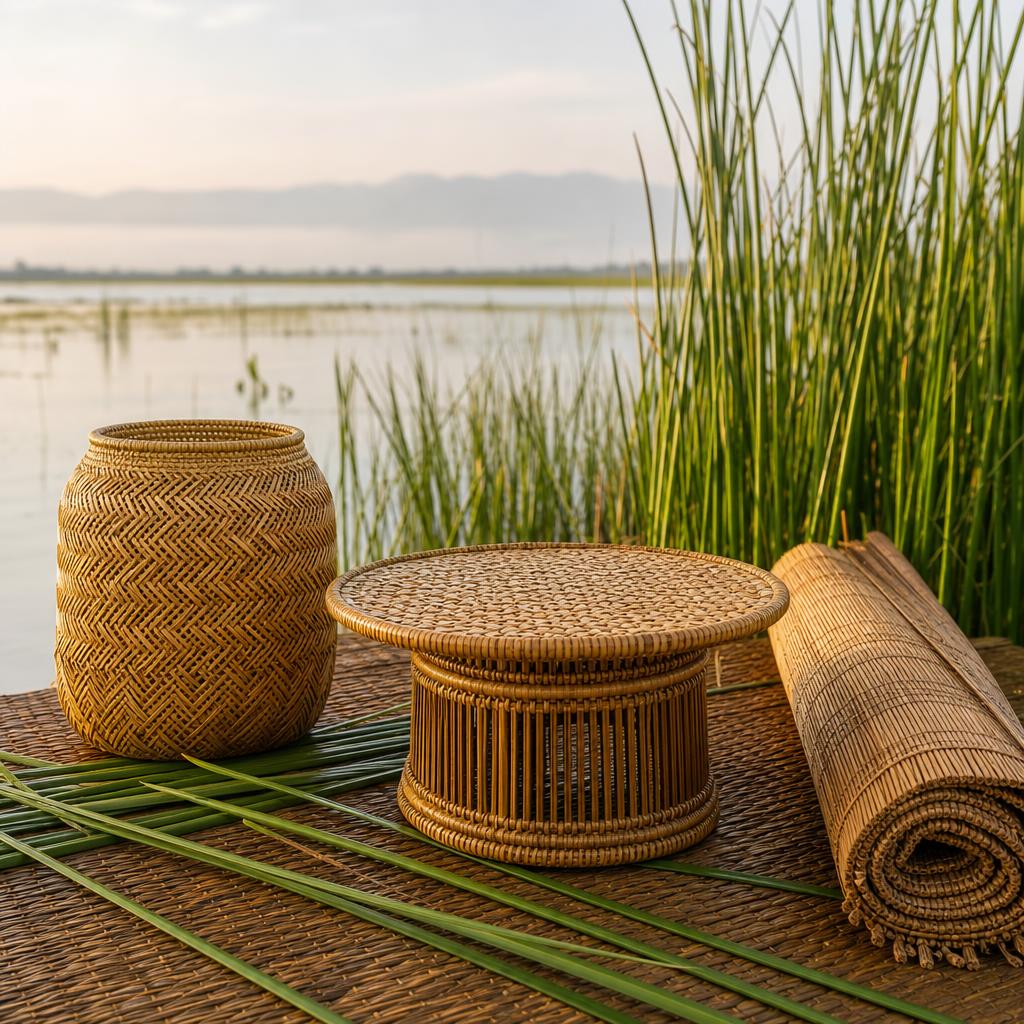
Kouna Craft of Manipur: Weaving Wetlands into Everyday Life
In the low-lying wetlands and paddy landscapes of Manipur grows a tall, slender reed known locally as Kouna or Kauna. Standing green in shallow water, it may seem like part of the background. Yet after harvesting, drying, sorting, and patient weaving, these stems become mats, baskets, bags, storage vessels, stools, and quiet objects for everyday life.
Kouna craft begins in a landscape. Its beauty comes not from disguising the reed, but from understanding its natural length, flexibility, strength, and warm golden colour.
What Is Kouna?
Kouna is a grass-like aquatic reed cultivated in the wet areas of Manipur. Research literature commonly identifies it as Schoenoplectus lacustris, a member of the sedge family. It thrives where land and water meet, producing long stems that can be dried and woven without being split into very fine fibre.
The material is light yet resilient. Its rounded stems give a finished mat a soft, springy body, while tighter weaving can create surprisingly firm containers and furniture forms. Natural variation in tone—from pale straw to deeper honey brown—records differences in growth and drying rather than industrial uniformity.
A Craft Rooted in the Mat
The traditional Kouna mat is both humble and technically revealing. It requires long, even reeds; a clear understanding of tension; and steady spacing across a broad surface. Mats serve daily life—for sitting, resting, gathering, and organizing domestic space—and their usefulness helped keep the weaving knowledge active across generations.
Contemporary artisans and enterprises have expanded this foundation into baskets, shopping bags, planters, trays, boxes, lampshades, and furniture. The new objects do not abandon the mat tradition. They apply the same material understanding to curves, corners, handles, lids, and load-bearing forms.
From Wet Field to Golden Reed
The finished object begins months before weaving. Kouna is cultivated in wet ground and harvested when the stems have reached a useful height and maturity. The reeds are cut, bundled, cleaned, and dried—often in sunlight—until their green surface turns warm and straw-like.
Drying must be handled with care. Moisture left inside the stems can encourage mould, while over-dry reeds may become brittle. Artisans sort the material by length, thickness, colour, and quality, selecting different stems for the body, edge, structural support, or finer finishing of an object.

How Kouna Is Woven
1. Softening and sorting
Dried reeds are selected and, when needed, lightly moistened or conditioned so they bend without cracking.
2. Laying the foundation
For a mat, parallel stems establish the first direction. A second set is passed over and under them, gradually locking the surface together.
3. Controlling tension
The artisan keeps each row close and even. Small inconsistencies can travel across the weave, so hands repeatedly align and compress the reeds.
4. Building volume
For baskets or furniture, the weave turns upward around a frame or structural base. Shaping requires the reed to bend while maintaining an even surface.
5. Securing the edge
Rims, corners, handles, and joins are reinforced because they receive the greatest wear. Careful finishing determines both durability and comfort in use.
Wetland Knowledge and Rural Livelihoods
Kouna craft connects farming, ecology, and handwork. Cultivators understand water levels, soil, seasons, and the timing of harvest. Weavers understand how the same plant behaves after drying. In many communities, the craft supports home-based and rural livelihoods, including work by women who combine weaving with agricultural and family responsibilities.
The material is renewable and biodegradable, offering a plant-based alternative to many plastic household objects. But environmental value should not be reduced to a marketing phrase. Healthy wetland systems, careful cultivation, reliable raw-material access, fair prices, and durable product design all shape whether the craft is genuinely sustainable.
Designing Beyond the Traditional Mat
The evolution of Kouna into contemporary storage, lighting, bags, and furniture has opened new markets for Manipur’s artisans. Designers can help refine proportion, ergonomics, and finishing, while artisans contribute the deeper knowledge: which reeds can curve, where a structure needs reinforcement, and how much tension the material will bear.
The strongest collaborations treat craft knowledge as design expertise. They do not simply send a drawing to a village and ask for production. They begin with the possibilities and limits already held in the artisan’s hands.
Kouna in the Contemporary Home
Kouna’s natural surface brings warmth without heaviness. A woven basket softens a hard shelf; a mat adds texture beneath the body; a low stool or table carries the rhythm of hundreds of repeated crossings. Because the reed is left visually honest, it pairs easily with wood, cotton, linen, clay, and other natural materials.
Its irregularities are part of its character. Slight shifts in colour and diameter remind us that the object began as a living stem, shaped by water and weather before it was shaped by hand.
Carrying the Wetland Home
At The Parijat Tree, we are drawn to crafts that keep us connected to their place of origin. Kouna does this with unusual clarity. Its long stems carry the memory of Manipur’s wet fields into every woven crossing.
To value Kouna craft is to value an entire chain of knowledge—from cultivation and drying to sorting, shaping, and finishing. The final object may be simple, but its simplicity is earned through intimacy with a material and the landscape that grows it.
Every craft has a story, Every story a soul.
Sources and further reading: A Study of Kouna Products in Manipur and Their Marketability; Tarasha: Kauna Reed Craft of Manipur; Government of Manipur: Directorate of Handlooms & Textiles.
Image note: The hero and process visuals are original editorial illustrations created for The Parijat Tree. They are interpretive representations of the craft’s materials and techniques, not documentary photographs of a specific textile, artwork, or artisan.